

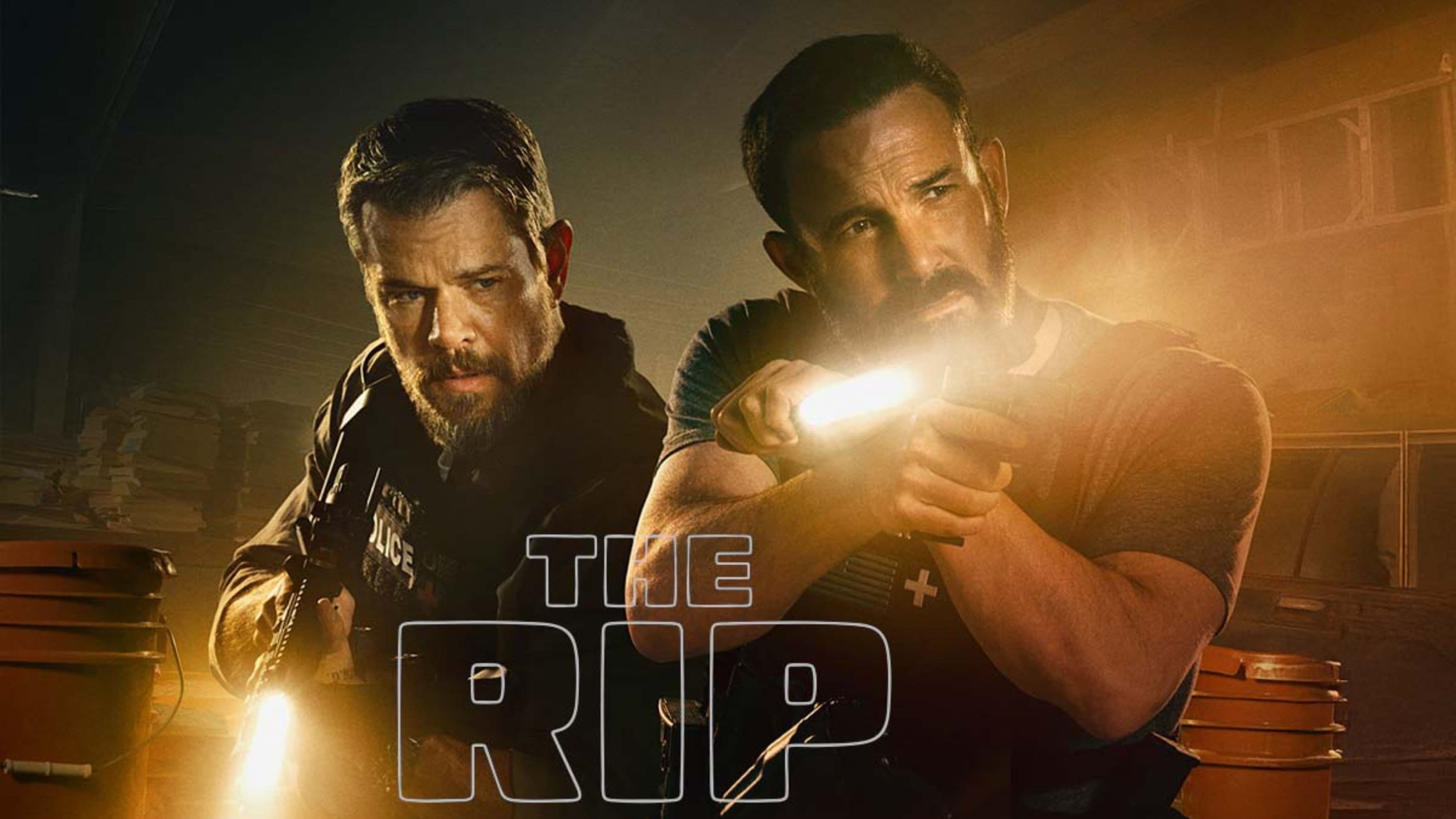
Not Your Average Thriller
The Rip arrives in a crowded genre space and immediately refuses to play by its rules. Where most psychological thrillers rely on jump scares and misdirection, this film builds its tension through restraint — long silences, tight close-ups on hands and eyes, and a sound design that makes even a closing door feel like a threat. It's the kind of movie that doesn't raise its voice because it doesn't have to. The dread is already in the room.
What sets it apart structurally is its refusal to give the audience a safe character to anchor to. Every major player is compromised in some way — morally, emotionally, or factually. You're never entirely sure whose version of events to believe, and the film exploits that uncertainty with surgical precision. By the time you think you've found solid ground, you realize you've been standing on the same shifting current the whole time.
The Ocean as a Character
Water is everywhere in this film, and it means something different in every scene. Early on, it's beautiful — wide shots of coastline that feel almost peaceful, the kind of scenery that makes you want to exhale. But The Rip slowly corrupts that beauty. The same ocean that looks inviting at dawn becomes something predatory by dusk, its surface catching light in ways that feel less like nature and more like a warning.
The rip current of the title operates as the film's central metaphor, and director uses it with real intelligence. A rip current doesn't announce itself. It doesn't look dangerous from the shore. It pulls you sideways before you realize you've moved at all — and by then, swimming against it only exhausts you faster. That's exactly what happens to every character in this story. They're all caught in something they didn't see coming, fighting in the wrong direction, burning out before they understand the shape of what has them.
The production design reinforces this at every turn. Homes feel slightly off-level. Furniture is placed just far enough from the walls to be uncomfortable. Even the color grading shifts almost imperceptibly across the film's second act — greens becoming grayer, blues deepening toward black. Watch it twice and you'll catch things your eyes registered but your brain was too busy to process the first time.
Performances That Get Under Your Skin
The lead performance here is one of those rare pieces of screen acting that doesn't feel like acting at all. Every hesitation, every micro-expression, every moment of stillness communicates something the script doesn't spell out. You'll find yourself studying faces during scenes where the dialogue is mundane, because the real conversation is happening in the half-second pauses and the eyes that won't quite meet. It's the kind of work that makes you feel like you're reading someone's actual thoughts, and that intimacy is deeply unsettling.
The supporting cast matches that energy without overshadowing it. There's a particular scene midway through the film involving two characters and a kitchen table that contains more tension per square inch than most action sequences deliver in ten minutes. Nobody raises their voice. Nobody makes a sudden move. The camera barely cuts. And yet your pulse will be hammering by the time it ends, because The Rip understands something essential: the most frightening thing isn't what people do. It's what they're clearly capable of doing and haven't yet.
The Script Doesn't Explain Itself
One of the bolder choices The Rip makes is its commitment to ambiguity. This is not a film that circles back to explain everything. Key events are presented once, at angles that prevent certainty, and then the story moves on without apology. For audiences trained on tidy resolutions, this can feel disorienting — and that disorientation is entirely intentional. The film trusts you to sit with unresolved questions, and in doing so, it respects your intelligence in a way that mainstream genre filmmaking rarely does.
The dialogue is spare and carefully weighted. Characters don't monologue their motivations. When someone says something revealing, it usually comes wrapped in something banal — a comment about groceries, a question about the weather — and you feel the weight of it land in your chest before your brain catches up to why. That gap between emotional impact and conscious understanding is where The Rip lives, and it's a genuinely uncomfortable address.
Sound Does Half the Work
Close your eyes during any five-minute stretch of The Rip and you're still watching a different kind of horror film. The sound design is extraordinary — not in a showy way, but in the way that good sound design operates best: invisibly, underneath your awareness, shaping how you feel about what you're seeing without ever announcing itself. The ocean is always present on the soundtrack, even in interior scenes. Sometimes it's barely a breath. Other times it swells just enough to notice, then recedes before you can name it.
The score takes a similar approach. Rather than swelling dramatically at moments of tension, it frequently drops out entirely — leaving silence where music would normally reassure you that things are under control. The absence of a safety net is more alarming than anything a composer could add. You lean forward into those quiet moments without meaning to, straining to hear what's coming, and the film uses that instinct against you every single time.
Why It Hits Differently Right Now
The Rip would have been a strong film in any era, but it feels particularly resonant at this moment. Stories about invisible forces pulling people off course, about the gap between what looks safe and what actually is, about the exhaustion of fighting something you can't see clearly — these themes are landing with unusual force on contemporary audiences. There's something in the current cultural air that makes this film feel less like a story and more like a diagnosis.
Research on narrative transportation — the psychological phenomenon of being "absorbed" into a story — suggests that films dealing with themes of loss of control and hidden threat generate measurably higher emotional engagement than those built on more explicit danger. A 2020 study in Psychology of Aesthetics, Creativity, and the Arts found that audiences report stronger and longer-lasting emotional responses to films where threat is implied rather than shown, particularly when those themes mirror real-world anxieties. The Rip seems to understand this instinctively. It pulls at threads you didn't know were loose.
The Ending Will Follow You Home
Without giving anything away: The Rip ends on an image rather than a conclusion. The final shot is held long enough to become uncomfortable, and then it cuts to black while you're still deciding how to feel about it. You'll drive home — or close your laptop — with that image sitting somewhere behind your eyes, and it'll still be there when you wake up the next morning. That's not a flaw. That's a filmmaker doing exactly what they set out to do.
The best thrillers don't just entertain you; they leave a residue. They change the quality of the air in the room for a while after the credits roll. The Rip earns that status — not through spectacle or shock, but through the slow, deliberate accumulation of dread, delivered by a cast and crew who clearly understood exactly what kind of film they were making. It's the kind of movie that makes you want to talk about it immediately, and also makes you not quite sure where to start.
Should You Watch It?
If you're the kind of viewer who finds conventional thrillers too neat, too loud, or too eager to reassure you — yes, absolutely. The Rip is made for people who are willing to lean into discomfort and trust a film that refuses to spell everything out. It rewards patience, attention, and a willingness to sit with ambiguity long after the viewing is over. That's a rarer quality in cinema than it should be, and it's worth seeking out.
If you need your movies to resolve cleanly and leave you feeling settled, this one might genuinely frustrate you — and that's fair. The Rip is not interested in comfort. It's interested in truth, in the way that the most honest films always are: a little jagged, a little cold, and impossible to fully shake loose.
📚 Sources
Green, M. C., & Brock, T. C. (2000). The role of transportation in the persuasiveness of public narratives. Journal of Personality and Social Psychology, 79(5), 701–721. https://doi.org/10.1037/0022-3514.79.5.701
Hanich, J., Wagner, V., Shah, M., Jacobsen, T., & Menninghaus, W. (2014). Why we like to watch sad films: The pleasure of being moved in aesthetic experiences. Psychology of Aesthetics, Creativity, and the Arts, 8(2), 130–143.
Zillmann, D. (1996). The psychology of suspense in dramatic exposition. In P. Vorderer, H. J. Wulff, & M. Friedrichsen (Eds.), Suspense: Conceptualizations, Theoretical Analyses, and Empirical Explorations. Lawrence Erlbaum Associates.
Bezdek, M. A., & Gerrig, R. J. (2020). Implied versus explicit threat in narrative film: Emotional engagement and memory retention. Psychology of Aesthetics, Creativity, and the Arts, 14(3), 312–324.