
Whether you're a lifelong PC shooter veteran or someone who just picked up their first gamepad, understanding what made these games extraordinary will deepen your appreciation for every FPS you play today. Let's break them down.
1. DOOM (1993) — The One That Started the Fire
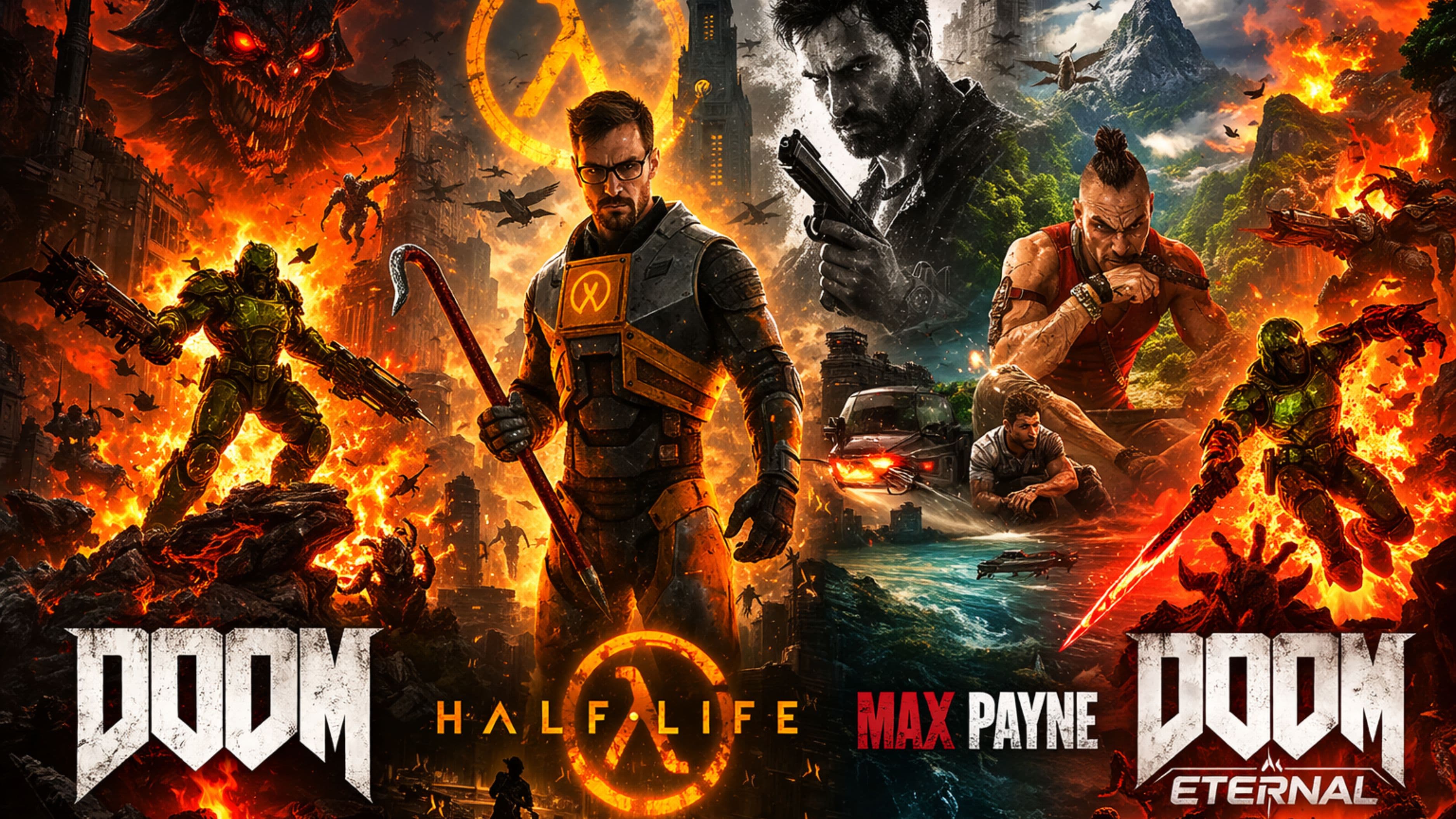
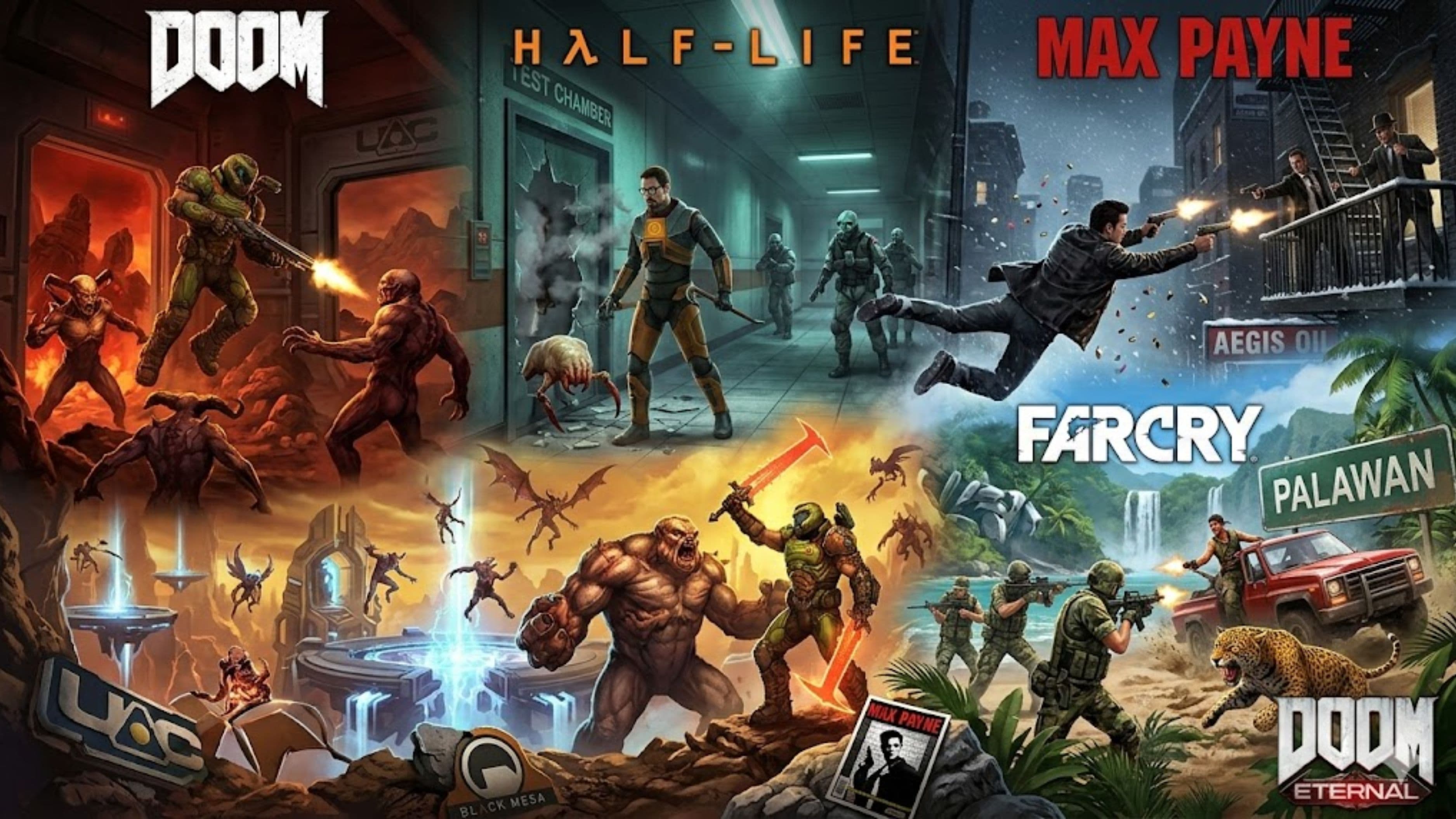
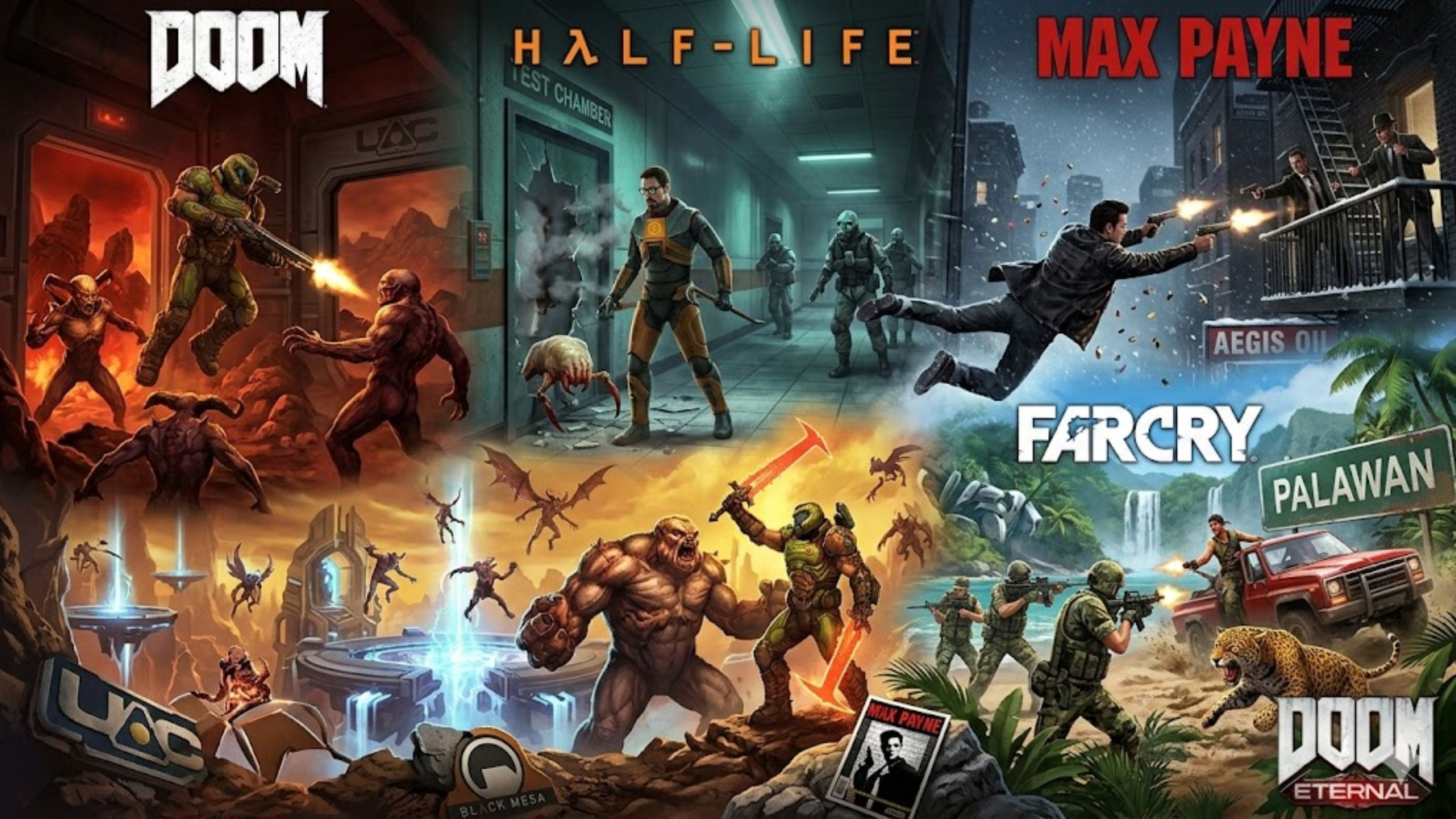
Before DOOM, the idea of moving through a 3D space and blasting enemies felt like science fiction. When id Software dropped this game on December 10, 1993, it didn't just launch a genre — it ignited a cultural firestorm. Office networks crashed because employees were playing it on company time. Religious groups called it dangerous. Parents panicked. And gamers? Gamers absolutely lost their minds with joy.
What made DOOM so revolutionary wasn't just the visuals (though watching those hellish corridors load up for the first time was genuinely shocking). It was the speed — that relentless, heart-thumping momentum that punished you for standing still. DOOM understood something most developers hadn't figured out yet: a shooter should feel like a fight for survival, not a gallery walk. The sound design alone — the wet crunch of a shotgun blast, the guttural growls of demons echoing around corners — made your palms sweat just booting it up.
DOOM also pioneered shareware distribution, making the first episode free and downloadable. That single business decision reshaped how games reached players and arguably laid the foundation for what we now call free-to-play models.
2. Half-Life (1998) — Storytelling Gets Loaded
When Valve released Half-Life in November 1998, it asked a question nobody had really posed before: What if an FPS had a story worth caring about? Gordon Freeman — a silent, crowbar-wielding physicist in an HEV suit — became one of gaming's most iconic protagonists without speaking a single word. That's not a design quirk; it's a masterclass in immersion.
Half-Life stripped away cutscenes and put everything directly in the player's hands. The alien resonance cascade disaster at Black Mesa unfolded around you in real time, with scientists screaming, marines turning hostile, and headcrabs lunging from the dark. You didn't watch the story — you lived inside it, feeling the claustrophobia tighten with every ventilation shaft you crawled through. The game trusted players to be curious, and that trust changed narrative design across the entire industry.
According to game designer and critic Clint Hocking, Half-Life fundamentally demonstrated that environmental storytelling could carry a game's emotional weight just as effectively as scripted dialogue — a lesson still echoing through modern FPS design today.
3. Max Payne (2001) — When Style Became a Mechanic
Max Payne walked into the FPS-adjacent space of third-person action and did something outrageously bold: it made slowing down feel faster than anything you'd ever played. Bullet Time — borrowed from the cinematic language of The Matrix — wasn't a gimmick. It was the heartbeat of the game's identity. Leaping sideways through a doorway while watching bullets trail through the air in slow motion felt like playing inside a noir action movie.
Remedy Entertainment's achievement here was emotional, not just technical. Max Payne was bleak — genuinely, uncomfortably dark. The graphic novel-style storytelling, the rainy New York streets, the haunted inner monologue of a man who'd lost everything and kept fighting anyway. You could feel Max's exhaustion seeping through the controller. The game made you understand that tone and atmosphere weren't decoration — they were gameplay. The tension of each corridor wasn't just about enemies; it was about dread, grief, and stubborn survival.
Max Payne's influence shows up everywhere, from the slow-motion mechanics in Control to the cinematic combat choreography of modern action titles.
4. Far Cry (2004) — The Open World Breaks Free
Most FPS games in 2004 were still funneling players through tight, linear corridors. Crytek looked at that convention and essentially said, what if we just... didn't? Far Cry dropped you onto a massive tropical island with dense jungles, open beaches, and military outposts scattered across a map that felt genuinely, almost overwhelmingly, alive. The sun glinted off the water. The foliage swayed. And enemies — crucially — actually used tactics.
The AI in Far Cry was ahead of its time in ways that still impress. Enemies would flank you, call for backup, retreat and regroup. If you fired a shot in the jungle, the whole island seemed to hear it. That created a tension loop that most shooters hadn't managed: every engagement felt consequential because stealth, positioning, and planning mattered as much as aim. You could approach the same outpost a dozen different ways and never have the same experience twice.
Far Cry essentially wrote the blueprint for open-world FPS design that games like Far Cry 3, Crysis, and even Elden Ring's open encounters would later build on — a legacy of tactical freedom baked into open geography.
5. DOOM Eternal (2020) — The Genre Teaches Itself New Tricks
Twenty-seven years after the original DOOM redefined action gaming, id Software did it again. DOOM Eternal didn't just update the formula — it interrogated it. Where most modern shooters encouraged cover mechanics and careful resource management, Eternal leaned hard into aggression as survival strategy. Running low on health? Chainsaw an enemy for ammo. Taking damage? Glory kill for health. The game punished passivity so effectively that standing still felt physically wrong.
The combat in DOOM Eternal operates like a brutal, high-speed puzzle. Each encounter is a symphony of movement, weapon-switching, and priority targeting — learning which demons to kill first, which weapons they're vulnerable to, and how to chain kills into resource generation. The result is combat that feels simultaneously chaotic and deeply satisfying, like a dance where the choreography only reveals itself after you've been knocked down a dozen times.
According to PC Gamer, DOOM Eternal's combat system was praised for "demanding mastery in a way few shooters dare," with many critics pointing to its layered mechanics as evidence that the FPS genre still has unexplored creative territory ahead of it.
Why These Five Still Matter
What ties these games together isn't just critical acclaim or sales numbers — it's the fact that each one forced the entire industry to adapt. DOOM gave FPS games their pulse. Half-Life gave them a soul. Max Payne gave them style. Far Cry gave them space. DOOM Eternal reminded everyone that innovation doesn't have an expiration date. If you haven't played all five, consider this your sign. Each one is a short course in why we love this medium — and each one will leave a mark that doesn't wash off.
📚 Sources
Kushner, D. (2003). Masters of Doom: How Two Guys Created an Empire and Transformed Pop Culture. Random House.
Hocking, C. (2007). "Ludonarrative Dissonance in Bioshock." Click Nothing (design blog). Referenced widely in game design scholarship.
PC Gamer Staff. (2020). "DOOM Eternal Review." PC Gamer. https://www.pcgamer.com/doom-eternal-review/
Kent, S. L. (2001). The Ultimate History of Video Games. Three Rivers Press.
id Software. (1993). DOOM shareware release documentation and distribution history. Archived at the Internet Archive.